
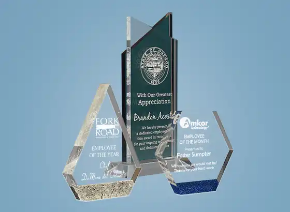
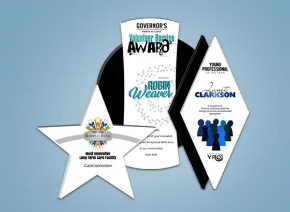
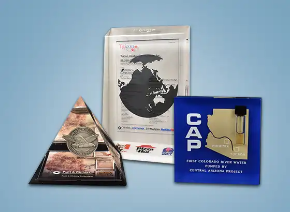
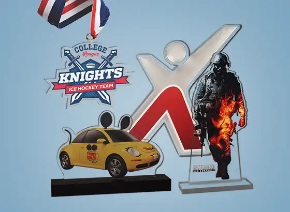
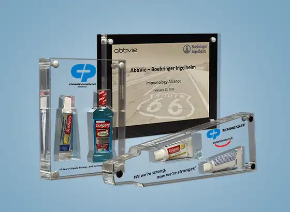

A custom acrylic award often begins with something surprisingly simple.
It might be a company logo, a photograph, a rough sketch, an event graphic, or an idea someone has been carrying around in their head. Finished artwork is always helpful, but it isn't a requirement.
That's an important distinction because customers sometimes hesitate to begin a custom award project until they have every detail worked out. They assume they need to know the shape, dimensions, printing method, acrylic thickness, or even how the award should be manufactured.
You don't.
At US Acrylic Awards, part of our job is taking what you already have and determining how it can become a finished recognition piece. Our design and production teams work together throughout that process, from the first concept and digital proof through manufacturing and final inspection.
Here's what happens after you send us your artwork or idea.
It Doesn't Have to Start With Finished Artwork
Some customers come to us with professionally prepared artwork and a clear idea of what they want. Others have little more than a logo and an explanation of the achievement they're recognizing.
Both are perfectly good places to start.
A sketch can show us the general direction you have in mind. A photograph can become part of the finished artwork. A company or event logo may inspire the shape of the award itself. Text, brand colors, project graphics, and other visual elements can all help our designers understand the story the finished piece needs to tell.
The first step isn't determining whether your file is ready for production. It's understanding what you want the award to accomplish.
Who is receiving it? What are they being recognized for? Which elements of your organization, project, event, or achievement should be represented?
Once we understand that, we can begin determining how the artwork should translate into acrylic.
Turning an Idea Into an Award Design

This is where experience with both design and manufacturing becomes important.
Our designers aren't simply placing a logo onto a predetermined template. They're looking at the artwork and considering what can be done with it.
A logo with a distinctive outline, for example, may be a good candidate for a custom contour. The shape of the logo can influence the silhouette of a LaserCut™ Acrylic Award, while another portion of the design provides room for the recipient's name, achievement, date, or other wording.
Other projects may call for a more traditional acrylic shape with detailed graphics, dimensional elements, engraving, or embedded materials.
Because we manufacture the awards ourselves, our design team understands what can actually be produced. That allows us to explore ideas while keeping balance, material thickness, printing, fabrication, and the overall quality of the finished award in mind.
There are very few appropriate concepts we can't find a way to produce. At the same time, we won't recommend a design that doesn't represent the quality and style people expect from US Acrylic Awards.
The goal isn't simply to make the artwork fit. It's to make the artwork work as an award.
For another look at how logos and concepts influence recognition design, read From Logo to Recognition Piece.
Seeing Your Award Before It's Made
One of the most common concerns with a custom project is also one of the most understandable: what is this actually going to look like when it's finished?
Digital proofing takes much of that uncertainty out of the process.
Once we understand the concept and have the necessary assets, our team creates the first design proof. The customer can see how the artwork, wording, shape, colors, and other elements work together before production begins.
If something isn't right, we talk about it. Maybe the wording needs to move. Perhaps a logo should be larger. A contour might need adjustment, or the overall design may need to move in another direction.
We make the appropriate changes and send the revised proof back for review. In our experience, most projects are ready to move into production after that initial proof-and-revision process.
For larger orders, a physical sample may also be available when the project requires one and the production schedule allows enough time.
The important part is approval. Nothing moves into production simply because we think the design is finished. The customer sees and approves the design before the order is manufactured.
The Design Determines How We Make It

There isn't one production process that works for every custom acrylic award.
That's part of what makes acrylic such a versatile recognition material.
If a customer's artwork contains detailed brand colors, photographs, gradients, or other graphics, full-color UV printing may be an important part of the production process. Reverse printing and white underlays can create crisp, vibrant graphics while preserving the polished appearance of clear acrylic.
When a logo, mascot, product, or graphic lends itself to a distinctive silhouette, precision laser cutting can allow the artwork to influence the physical shape of the award. Our LaserCut™ Acrylic Awards Spotlight explores that process in more detail.
Some designs are better suited for laser engraving, which can produce clean text, logos, and details directly in the acrylic.
Other projects begin with an object that the customer wants preserved inside Lucite®. In those cases, we determine the appropriate shape, thickness, and presentation for an acrylic embedment that showcases the item while creating a finished piece suitable for recognition or display.
And sometimes the right answer is to use several processes together.
We don't begin by deciding which machine we want to use. We begin with what the customer wants to create and determine which of our production capabilities will produce the strongest finished award.
From Approved Proof to Production
Once the customer approves the design, the project moves from the computer screen into production.
What happens next depends on the award.
A LaserCut™ project may require acrylic to be precisely cut around a custom contour before the individual pieces are finished and assembled. Printed awards require artwork preparation and careful control of color, white ink, transparency, and print placement. Engraved pieces have their own production requirements.
Embedments add another layer of complexity because the item or design must become part of the acrylic itself.
Cutting, polishing, printing, engraving, embedding, assembly, and finishing may all play a role depending on the project.
Consistency matters too, particularly when we're producing a larger order. Each piece needs to meet the same dimensional and visual standards so the first award and the last award look like they belong together.
The manufacturing process may change from project to project. Our quality expectations don't.
Customers looking for more traditional recognition formats can also explore our Acrylic Awards and Acrylic Trophies collections.
One Project, Several Manufacturing Processes

A custom deal toy created for the acquisition of Brandman University by UMass is a good example of how several capabilities can come together in one finished piece.
The customer began by explaining the purpose of the deal toy. From there, our team gathered the assets needed to tell the story, including the UMass, Brandman University, and Chapman University logos, building imagery, transaction information, and supporting text.
Our designers combined those elements into a digital concept and sent it to the customer for approval.
Once the design was approved, production began.
The finished piece incorporated a red embedded layer inside the clear acrylic block. The blocks were cut and polished to consistent dimensions and inspected against our quality standards.
The building image was reverse printed in black and white on the back of the piece, creating visual depth behind the embedded red layer. The primary design and three institutional logos were then printed in full color on the front, with a white underlay used to help the colors remain vivid.
The result wasn't created by choosing one production technique.
Embedment, fabrication, polishing, reverse printing, full-color printing, and careful artwork preparation all contributed to the final piece.
More importantly, each technique had a reason for being there. Together they turned the story of an acquisition into a physical piece the recipients could keep and display.
You can explore additional examples of this type of work in our Custom Deal Toy Gallery.
Custom Doesn't Mean You Have to Figure It Out Yourself
Custom awards offer more possibilities, but that shouldn't mean more work for the customer.
If you already have completed artwork, send it to us.
If you have a logo and aren't sure what to do with it, send that.
If someone sketched an idea during a meeting, we'd rather see the sketch than have you wait weeks trying to turn it into production artwork yourself.
Our designers work with these materials every day. They understand how artwork behaves on clear acrylic, when a white layer will improve printed color, how a contour needs to be structured for laser cutting, when engraving makes sense, and how different manufacturing processes can work together.
That experience is part of what you're getting when you order a custom award.
You're not simply submitting a file to a machine. You're working with people who know how to turn that file into something that can be manufactured well.
From Your Artwork to the Finished Award
Every custom project follows its own path.
A straightforward logo award may move from artwork to proof and production relatively quickly. A complex recognition piece might combine custom fabrication, multiple printed surfaces, engraving, embedded elements, or other production techniques.
The starting point remains remarkably simple.
Tell us what you're trying to recognize and show us what you have.
From there, we'll help determine what the award can become, create a design you can review, make adjustments when they're needed, and manufacture the approved piece using the processes best suited to the project.
The customer brings the story. Our job is figuring out how to make it an award.
Have an Idea for a Custom Acrylic Award?
You don't need finished artwork or every detail worked out before getting started. If you have a logo, sketch, photograph, or an idea for an award, our team is here to help you determine the next step.
Tell us what you're working on, and we'll help you explore how your idea can become a finished recognition piece.
Contact US Acrylic Awards


